
Nanomaterial-Based Memristors for Neuromorphic Computing: Materials, Device Architectures, and Emerging Applications
Abstract
The increasing computational demands of Artificial Intelligence (AI) and data-intensive applications have stimulated the development of energy-efficient and highly integrated computing technologies. Neuromorphic computing has emerged as a promising alternative to conventional von Neumann architectures by integrating memory and computation and emulating key functionalities of biological neural systems. In this context, memristive devices have attracted significant attention because of their nanoscale dimensions, history-dependent resistance modulation, multilevel conductance states, and potential for implementing artificial synapses and neurons. The incorporation of nanomaterials has further expanded the capabilities of memristive devices by enabling tunable electrical, structural, and interfacial properties. This review provides an overview of recent advances in nanomaterial-based memristors for neuromorphic computing, with emphasis on the major classes of nanomaterials, including Two-dimensional (2D) materials, metal oxides, nanoparticles, quantum dots, nanocomposites, and emerging hybrid systems. Different device architectures and their roles in resistive switching, synaptic plasticity, multilevel operation, and in-memory computing are discussed. The emerging applications of nanomaterial-based memristors in Artificial Neural Networks (ANNs), edge AI, image and pattern recognition, signal processing, robotics, and Internet-of-Thing’s systems are also reviewed. In addition, key performance characteristics and technological challenges, including switching speed, energy consumption, endurance, retention, variability, scalability, and Complementary Metal-Oxide-Semiconductor (CMOS) compatibility, are critically discussed. Finally, emerging research directions involving 2D heterostructures, three-dimensional architectures, flexible electronics, and hardware-algorithm co-design are highlighted. This review provides an integrated perspective on the relationship between nanomaterial properties, memristive device architectures, and neuromorphic functionality, offering insights into the development of scalable and energy-efficient hardware for next-generation intelligent computing systems.
Keywords:NanomaterialsNeuromorphic computingResistive switchingArtificial synapsesArtificial intelligenceEdge
computing, Nanotechnology.
1. Introduction
The rapid development of Artificial Intelligence (AI), machine learning, and data-intensive applications has created an increasing demand for computing systems that can process large volumes of information with high speed and low energy consumption [1–4]. Conventional computing architectures based on the von Neumann paradigm face fundamental limitations because data storage and processing are physically separated, resulting in substantial data-transfer overhead and energy consumption. These limitations have motivated the development of alternative computing paradigms, among which neuromorphic computing has attracted considerable attention. Inspired by the structure and functionality of the biological brain, neuromorphic systems aim to integrate memory and computation and to perform information processing in a highly parallel, adaptive, and energy-efficient manner [5–7]. Memristive devices have emerged as promising hardware components for neuromorphic computing because their electrical resistance can be continuously or discretely modulated according to the history of applied electrical stimuli. This behavior enables memristors to emulate important characteristics of biological synapses, including synaptic weight modulation, short and long-term plasticity, and spike-dependent learning. In addition, their ability to perform memory and computational functions within the same physical device makes them particularly attractive for in-memory and brain-inspired computing architectures. Compared with conventional transistor-based systems, memristive devices can potentially provide high integration density, low operating energy, fast switching, and compatibility with large-scale crossbar architectures. The rapid progress of nanotechnology has further expanded the potential of memristive systems. Nanomaterials offer unique electrical, optical, mechanical, and physicochemical properties that can be tailored through their composition, dimensionality, morphology, and interfacial structure. Two-dimensional (2D) materials, metal oxide nanomaterials, nanoparticles, quantum dots, nanocomposites, and emerging hybrid materials have therefore been extensively investigated as active layers, electrodes, charge-trapping media, or interfacial components in memristive devices. At the nanoscale, phenomena such as ion migration, defect formation, charge trapping, interfacial modulation, and conductive filament evolution can be effectively controlled to achieve resistive switching and analog conductance modulation. These characteristics are particularly important for reproducing the adaptive behavior required for neuromorphic information processing [8–10].
Among the different classes of nanomaterials, 2D materials have received considerable attention because of their atomic-scale thickness, tunable electronic properties, large surface-to-volume ratio, and potential for constructing vertically stacked and flexible devices. Similarly, metal oxide nanomaterials provide advantages such as relatively simple fabrication, good compatibility with existing semiconductor technologies, and well-established resistive-switching mechanisms. Hybrid nanomaterials and nanocomposites can additionally combine the advantages of different material classes, providing opportunities to improve switching characteristics, device stability, and neuromorphic functionality. Nevertheless, the performance of nanomaterial-based memristors depends strongly on material composition, defect chemistry, device architecture, fabrication conditions, and switching mechanism, making systematic comparison across different material systems challenging [11]. Beyond simple memory applications, nanomaterial-based memristors are increasingly being explored as computational elements for Artificial Neural Networks (ANNs), in-memory computing, edge intelligence, image and pattern recognition, signal processing, robotics, and Internet-of-Things (IoT) applications. Their capability for analog or multilevel conductance modulation is particularly relevant to hardware implementation of synaptic weights and matrix–vector multiplication, which are fundamental operations in neural-network computation. However, practical deployment remains constrained by several challenges, including device-to-device variability, stochastic switching, limited endurance, retention issues, sneak-path currents in large arrays, fabrication reproducibility, scalability, and integration with Complementary Metal-Oxide-Semiconductor (CMOS) technologies [12–15].
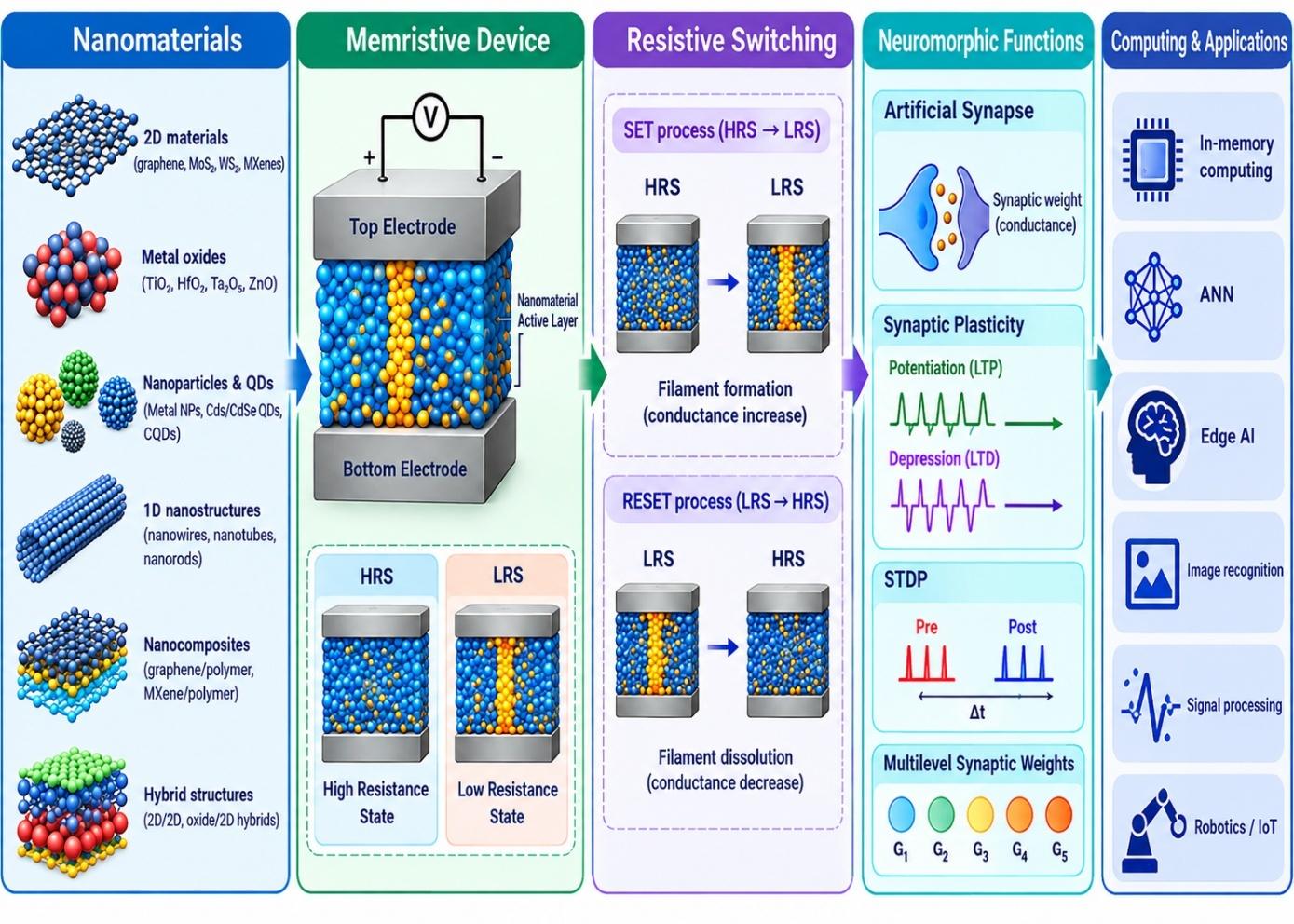
Although numerous studies have reported advances in individual nanomaterial systems and memristive architectures, the rapidly expanding literature has produced a diverse landscape of materials, switching mechanisms, device structures, and neuromorphic applications. A comprehensive understanding of the relationships between nanomaterial characteristics, resistive-switching mechanisms, device architectures, and neuromorphic functionality is therefore essential for identifying the opportunities and limitations of these technologies. In particular, a critical comparison of different nanomaterial platforms can provide valuable insights into the requirements for developing reliable, energy-efficient, and scalable neuromorphic hardware. This review provides a comprehensive overview of recent advances in nanomaterial-based memristors for neuromorphic computing, with emphasis on the relationship between material properties, device architectures, switching behavior, and computational functionality [15–19]. The major classes of nanomaterials employed in memristive devices are discussed, followed by an examination of their integration into different device architectures and their ability to reproduce synaptic and neuronal functions. Emerging applications in neuromorphic and in-memory computing are subsequently reviewed, with particular attention to energy efficiency, scalability, and practical implementation. Finally, the major challenges and future research directions are discussed to highlight the opportunities fo nanomaterial-enabled memristive technologies in next-generation intelligent electronic systems. Nanomaterial-based memristors integrate nanoscale material properties with resistive switching mechanisms to enable synaptic and neuromorphic functionalities. Their overall relationship from material selection and device operation to neuromorphic computing and emerging applications is schematically illustrated in Fig.1.
2. Fundamentals of Memristors for Neuromorphic Computing
Memristors are two-terminal electronic devices whose resistance can be modulated by external electrical stimuli and can retain information about their previous electrical states. This history-dependent behavior distinguishes memristors from conventional passive resistive elements and provides the fundamental basis for their use as non-volatile memory and computational devices. Depending on the material system and device structure, the resistance of a memristor can be reversibly switched between different states through mechanisms involving the redistribution of ions, vacancies, charges, or other electrically active species. The ability to control these resistance states is particularly attractive for implementing memory and processing functions within the same physical device [5].
The switching behavior of memristors is generally associated with changes in the conductivity of an active material under an applied voltage or current. Different physical mechanisms can contribute to this process, including the formation and rupture of conductive filaments, migration of oxygen vacancies or metal ions, charge trapping and detrapping, interfacial modification, and changes in the electronic or structural state of the active layer. Based on these mechanisms, memristive devices can exhibit different types of resistive switching behavior. Some devices demonstrate abrupt transitions between high- and low-resistance states, whereas others provide gradual and analog conductance modulation. The latter behavior is especially important for neuromorphic computing because biological synapses modify their strength continuously in response to neuronal activity [8].
Several performance parameters are commonly used to evaluate memristive devices. These include switching voltage, switching speed, resistance ratio, endurance, data retention, energy consumption, and operational stability. The resistance ratio between the high-resistance state and low-resistance state determines the distinguishability of memory states, while endurance represents the number of switching cycles that a device can withstand without significant degradation. Retention describes the ability of a device to preserve its programmed state over time. In neuromorphic applications, additional characteristics such as linearity of conductance modulation, symmetry between potentiation and depression, dynamic range, and cycle-to-cycle reproducibility become particularly important because they directly influence the accuracy of learning and information processing [12].
One of the most important advantages of memristors for neuromorphic computing is their ability to emulate the electrical behavior of biological synapses. By gradually changing their conductance in response to electrical pulses, memristive devices can reproduce synaptic plasticity, in which the strength of connections between neurons changes according to neuronal activity. Short-term and long-term changes in conductance can be obtained by controlling the amplitude, duration, frequency, and number of applied pulses. Such behaviors provide a physical basis for implementing learning and memory processes in ANNs. Some advanced memristive devices can also demonstrate Spike Timing Dependent Plasticity (STDP), in which the relative timing of electrical pulses determines whether the synaptic connection is strengthened or weakened [10–16]. In addition to artificial synapses, memristors can contribute to the realization of artificial neurons and other neuromorphic elements. Their nonlinear current-voltage characteristics, threshold behavior, and history-dependent response can be utilized to implement neuron-like functions such as signal integration, threshold activation, and firing. When large numbers of memristive devices are interconnected in crossbar or other array architectures, they can perform computational operations directly within the memory structure. This capability is particularly valuable for matrix-vector multiplication, which is one of the most computationally intensive operations in ANNs.
The combination of memory, analog conductance modulation, and computational functionality makes memristors attractive for in-memory computing, where data processing occurs close to or directly within the memory elements. This approach can reduce the repeated movement of data between conventional processing and memory units and thereby improve computational efficiency. Nanomaterials further enhance these possibilities by enabling nanoscale device dimensions, tunable switching characteristics, and potentially high-density integration. Consequently, understanding the fundamental operating principles and performance requirements of memristors provides an essential basis for evaluating different nanomaterial platforms for neuromorphic computing [18–21]. As illustrated in Fig. 2, memristors are two-terminal devices whose resistance depends on the history of applied electrical stimuli. This unique behavior enables them to emulate biological synapses through gradual conductance modulation, support artificial neuron functions, and perform computational operations within crossbar arrays. The figure also summarizes the main physical switching mechanisms and critical performance metrics that determine the suitability of memristive devices for neuromorphic applications.
This figure is shown in the PDF version of the article.
3. Nanomaterials for Memristive Devices
The development of nanomaterials has significantly expanded the design possibilities of memristive devices by providing materials with tunable electrical, structural, and interfacial properties. At the nanoscale, changes in composition, dimensionality, defects, surface structure, and interfaces can strongly influence charge transport and resistive-switching behavior. As a result, nanomaterials can be employed not only as active switching layers but also as electrodes, charge-trapping components, interfacial modifiers, or elements of hybrid device structures [22]. The selection of an appropriate nanomaterial is therefore closely related to the desired switching mechanism, device architecture, neuromorphic functionality, and operating conditions. Nanomaterials with different dimensionalities and physicochemical properties have been explored for memristive and neuromorphic devices. The major material classes and their representative characteristics are summarized in Fig. 3 and Table 1 [1–4].
This figure is shown in the PDF version of the article.
Table 1. Major nanomaterial classes used in memristive devices for neuromorphic computing, with representative materials, key advantages, limitations, and applications.
This table is shown in the PDF version of the article.
3.1 Two-Dimensional Nanomaterials
2D nanomaterials have attracted substantial interest for memristive and neuromorphic applications because of their atomic-scale thickness, high surface to volume ratio, tunable electronic properties, and distinctive interfacial characteristics. Materials such as graphene, transition-metal dichalcogenides, hexagonal boron nitride, and MXenes provide a broad range of electrical and structural properties that can be exploited to control charge transport and resistive switching. Their ultrathin structures can facilitate strong interactions with neighboring layers and enable compact device configurations [21–26].
The presence of defects, vacancies, grain boundaries, and interfaces in 2D materials can play an important role in determining their switching characteristics. These features can provide pathways for charge transport or act as sites for charge trapping and ion migration. In addition, the possibility of combining different 2D materials into van der Waals heterostructures provides an opportunity to engineer interfaces and tailor the electrical response of memristive devices. Such characteristics make 2D nanomaterials particularly attractive for flexible, transparent, and high-density neuromorphic electronics.
3.2 Metal Oxide Nanomaterials
Metal oxide nanomaterials represent one of the most extensively investigated material families for resistive switching. Oxides such as TiO₂, HfO₂, ZnO, NiO, and WO₃ have demonstrated memristive behavior through mechanisms commonly associated with defect migration, oxygen-vacancy redistribution, conductive filament formation, and interface modulation. Their relatively simple deposition processes and compatibility with established semiconductor fabrication technologies have contributed to their widespread investigation. The properties of metal oxide memristors can be modified through nanoscale control of composition, thickness, crystallinity, doping, and defect concentration. Such control can influence switching voltage, resistance states, endurance, retention, and energy consumption. In neuromorphic systems, metal oxide devices can also exhibit gradual conductance changes and pulse-dependent responses, allowing them to function as artificial synapses. However, controlling the stochastic nature of filament formation and achieving uniform device to device performance remain important challenges [26].
3.3 Nanoparticles, Quantum Dots, and Nanocomposites
Nanoparticles and quantum dots provide additional approaches for engineering memristive behavior through nanoscale charge confinement, interparticle interactions, and tunable energy states. Their incorporation into dielectric, polymeric, or inorganic matrices can introduce localized trapping sites and modify the pathways available for charge transport. By controlling particle size, concentration, distribution, and interface properties, the electrical response of the resulting devices can be tailored for specific memory and neuromorphic functions.
Nanocomposites can further combine two or more materials with complementary properties. For example, conductive nanomaterials can be integrated with insulating or semiconducting matrices to create controllable conduction pathways. Such hybrid structures can provide improved flexibility in designing switching characteristics and may support multilevel or analog resistance states. These properties are particularly relevant to neuromorphic systems, where multiple stable conductance states are desirable for representing synaptic weights [23–28].
3.4 Emerging and Hybrid Nanomaterials
Recent research has increasingly focused on hybrid and emerging nanomaterials to overcome the limitations associated with individual material systems. Heterostructures, polymer–nanomaterial composites, organic inorganic hybrids, and multifunctional nanomaterials can provide additional control over interfaces, charge transport, and switching mechanisms. Combining different materials can also enable the simultaneous optimization of electrical, mechanical, and optical properties, which is important for emerging flexible and multifunctional electronic systems.
An important advantage of hybrid nanomaterials is the possibility of designing the material system around the required neuromorphic function rather than relying on a single material property. For example, one component may provide efficient charge transport, while another control charge trapping or ionic movement. This approach can potentially improve switching stability, energy efficiency, and analog conductance modulation. Nevertheless, the increased structural complexity of hybrid systems can introduce challenges in fabrication reproducibility, interface control, long-term stability, and large-scale integration [19–21].
Nanomaterials provide a versatile platform for tailoring the electrical and switching properties of memristive devices. The diversity of available materials enables the development of devices with different resistance states, switching mechanisms, and neuromorphic behaviors. However, material selection alone does not determine device performance; the interaction between nanomaterial properties, interfaces, device architecture, and switching mechanism must also be considered. This relationship is particularly important when transitioning from individual nanoscale devices toward integrated memristive arrays for practical neuromorphic computing.
4. Device Architectures and Neuromorphic Functionality
The performance of nanomaterial-based memristors is strongly influenced by their device architecture, which determines the interaction between the active material, electrodes, interfaces, and external electrical stimuli. Although the basic memristive device typically consists of an active switching layer positioned between two electrodes, variations in layer configuration, electrode materials, device dimensions, and array organization can substantially modify the electrical and switching characteristics. Consequently, device architecture represents an important design parameter for achieving reliable memory operation and neuromorphic functionality. The major memristive device architectures and their key characteristics, advantages, limitations, and representative applications are summarized in Table 2 [9–12].
Conventional Metal Insulator Metal (MIM) structures are among the most widely used architectures for nanomaterial-based memristors. In these devices, a nanoscale active layer is positioned between two conductive electrodes, and resistive switching is induced by applying an electrical bias. The relatively simple structure facilitates the investigation of switching mechanisms and enables the integration of a wide range of nanomaterials. By modifying the thickness and composition of the active layer or engineering the electrode interfaces, different switching behaviors and resistance states can be obtained.
More advanced architectures have been developed to address the requirements of high-density neuromorphic computing. Crossbar arrays are particularly important because they enable large numbers of memristive elements to be interconnected in a compact configuration. In such architectures, individual memristors can represent synaptic weights, while electrical signals applied across the rows and columns can perform parallel computational operations. This capability provides an efficient physical platform for matrix–vector multiplication and in-memory processing. However, issues such as sneak currents, device variability, and programming accuracy become increasingly significant as array dimensions increase.
The nanoscale nature of many memristive devices also enables the development of vertical, flexible, and three-dimensional architectures. Vertical configurations can reduce device footprint and potentially increase integration density, while flexible architectures allow memristive devices to be incorporated into mechanically deformable electronic systems. These characteristics are particularly relevant to wearable electronics, soft robotics, and distributed sensing systems. Three-dimensional integration can further increase the number of computational elements within a limited physical area, although fabrication complexity and thermal management remain important considerations.
Beyond their role as memory elements, appropriately designed memristive devices can reproduce several fundamental functions of biological synapses and neurons. Analog conductance modulation allows a memristor to represent different synaptic weights rather than only binary states. By applying sequences of electrical pulses, the conductance can be progressively increased or decreased, corresponding to synaptic potentiation and depression. The resulting short-term and long-term plasticity provides a physical mechanism for implementing learning and adaptation in neuromorphic systems [29–31].
Another important characteristic is the ability to implement multilevel resistance states. Instead of restricting a device to high- and low-resistance states, controlled programming can generate multiple intermediate conductance levels. This capability increases the amount of information that can be stored in a single device and enables more efficient representation of synaptic weights. However, achieving well-separated and stable intermediate states requires precise control over switching dynamics and remains challenging because nanoscale processes can exhibit stochastic behavior.
The combination of suitable nanomaterials and advanced device architectures therefore provides a pathway toward increasingly sophisticated neuromorphic hardware. The design strategy is shifting from optimizing individual memory characteristics toward simultaneously addressing memory, computation, learning, energy efficiency, and integration density. Such multifunctional behavior is essential for the implementation of practical neuromorphic systems and provides the foundation for the emerging applications discussed in the following section.
Table 2. Memristive device architectures for neuromorphic computing.
This table is shown in the PDF version of the article.
5. Applications in Neuromorphic Computing
Nanomaterial-based memristors have attracted considerable attention as hardware platforms for neuromorphic computing because they can combine memory storage, signal processing, and learning functions within the same physical device. Their nanoscale dimensions, programmable conductance states, and history-dependent electrical response provide opportunities to implement computational operations with reduced data movement and potentially lower energy consumption. These characteristics are particularly relevant to AI applications in which large numbers of repetitive matrix operations must be performed
One of the most important applications of memristive devices is in-memory computing, in which data processing is performed directly within or close to the memory elements. Conventional computing systems frequently transfer data between memory and processing units, leading to communication overhead and increased energy consumption. In contrast, memristive crossbar arrays can store synaptic weights as conductance values while simultaneously performing electrical operations associated with matrix–vector multiplication. This approach can substantially reduce the need for repeated data transfer and provides a hardware-efficient framework for implementing neural-network computations [33–36].
Nanomaterial-based memristors are also being investigated for the hardware implementation of ANNs. The programmable conductance of individual devices can be used to represent numerical weights, while arrays of memristive elements can emulate interconnected layers of a neural network. Analog or multilevel resistance states are particularly useful in this context because they allow a broader range of synaptic weights to be represented within individual devices. The physical implementation of neural-network operations can consequently provide opportunities for parallel processing and improved computational efficiency compared
Another important application is edge AI, where data are processed locally on devices rather than being continuously transferred to centralized computing systems. Edge devices often operate under strict limitations in terms of power consumption, computational resources, and physical size. Nanomaterial-based memristors can address some of these requirements through their compact dimensions, low-power operation, and ability to perform memory and computation simultaneously. This makes them attractive for applications such as intelligent sensors, portable electronic systems, autonomous devices, and distributed IoT platforms.
Memristive neuromorphic systems have also demonstrated potential for image and pattern recognition. Electrical signals representing visual information can be processed through memristive arrays, where the conductance states of individual devices encode the parameters of computational models. The parallel processing capability of crossbar architectures can be particularly beneficial for feature extraction and classification tasks. Nanomaterial-based devices with analog switching behavior may further support adaptive learning by allowing their conductance to be modified in response to repeated input signals [37].
Beyond image processing, neuromorphic memristive hardware has potential applications in signal processing and sensory computing. The ability of memristors to respond dynamically to temporal input patterns makes them suitable for processing signals that contain both spatial and temporal information. This feature is relevant to applications involving speech, environmental sensing, biological signals, and other time-dependent data. In such systems, the inherent memory of the device can contribute to temporal information processing without requiring extensive external memory resources.
The combination of sensing and neuromorphic processing has additionally opened opportunities for intelligent and autonomous electronic systems. Nanomaterial-based memristors can potentially be integrated with sensors to create compact systems capable of detecting, storing, and interpreting information locally. Such architectures may be useful in robotics, wearable electronics, smart environments, and IoT networks, where rapid response and low-power operation are important. In robotics, for example, memristive hardware can contribute to adaptive control and sensory processing by providing hardware-level learning and pattern recognition capabilities [35]. The integration of memory, computation, and learning in nanomaterial-based memristive architectures enables their application across a broad range of neuromorphic systems, including in-memory computing, ANNs, edge AI, pattern recognition, temporal signal processing, and intelligent sensing platforms, as summarized in Fig. 4.
Despite these promising applications, the transition from laboratory-scale memristive devices to practical neuromorphic systems remains challenging. The computational accuracy of a memristive neural network depends not only on the intrinsic properties of individual devices but also on the uniformity, reliability, programming precision, and scalability of large arrays. Variations in resistance states, nonlinear conductance updates, device to device differences, and circuit-level parasitic effects can influence the overall performance of neuromorphic hardware. Therefore, future development requires simultaneous optimization of nanomaterial properties, device architecture, array design, algorithms, and system-level integration.
The emerging applications of nanomaterial-based memristors demonstrate that these devices can extend beyond conventional non-volatile memory toward multifunctional computing hardware. Their potential to integrate storage, computation, and learning within nanoscale architectures makes them promising candidates for energy-efficient AI and neuromorphic systems. However, achieving reliable large-scale implementation requires a careful balance between device-level performance and system-level requirements, which motivates a critical evaluation of their performance and remaining limitations.
This figure is shown in the PDF version of the article.
6. Performance, Challenges, and Limitations
The practical development of nanomaterial-based memristors for neuromorphic computing depends on achieving a suitable balance between electrical performance, reliability, energy efficiency, and scalability. Although a wide variety of nanomaterials and device architectures have demonstrated promising switching and synaptic behaviors, the performance reported at the individual device level does not always translate directly into reliable operation at the array or system level. Therefore, evaluating memristive devices requires consideration of multiple parameters simultaneously rather than relying on a single performance indicator. The performance of memristive devices is determined by several parameters, including switching speed, energy consumption, ON/OFF ratio, endurance, retention, multilevel capability, and variability. These parameters directly affect the efficiency, reliability, and accuracy of neuromorphic computing systems, as summarized in Table 3 [5–8].
Switching speed and energy consumption are among the most important parameters for neuromorphic applications. Fast switching enables rapid programming and information processing, while low switching energy is essential for developing energy-efficient AI hardware. Nanomaterials can provide short ion-migration distances, nanoscale conduction pathways, and localized switching regions, potentially reducing the energy required for resistance-state modulation. However, reducing the operating voltage or active volume does not necessarily guarantee stable switching, and optimization of the material composition, interfaces, and device dimensions is required to achieve both low energy consumption and reliable operation.
Endurance and retention are also critical for practical memristive systems. Endurance describes the ability of a device to withstand repeated programming and erasing cycles, whereas retention reflects its ability to maintain a programmed state over time. Neuromorphic applications may require frequent conductance updates during learning processes, making long-term endurance particularly important. At the same time, stable resistance states are necessary for preserving stored synaptic information. Degradation of active materials, irreversible structural changes, electrode interactions, and uncontrolled ion or vacancy migration can contribute to performance deterioration and limit the operational lifetime of devices [36–38].
A major challenge associated with nanoscale memristive systems is device-to-device and cycle-to-cycle variability. Resistive switching can involve localized processes such as conductive filament formation, defect migration, and charge trapping, which may exhibit stochastic behavior at the nanoscale. As a result, nominally identical devices can demonstrate different switching voltages, resistance states, or conductance-update characteristics. Such variability is particularly problematic for neuromorphic computing because neural-network performance depends on the accurate representation and modification of synaptic weights. Improving material uniformity, controlling defects and interfaces, and developing appropriate programming and error-compensation strategies are therefore important research directions.
The scalability of memristive devices presents another significant challenge. Crossbar arrays can provide high computational density and parallel processing, but increasing the number of interconnected devices introduces circuit-level problems such as sneak-path currents, parasitic effects, signal interference, and programming errors. The practical implementation of large arrays may consequently require additional selector devices, optimized circuit architectures, or advanced addressing strategies. Although such solutions can improve array reliability, they may also increase fabrication complexity, device footprint, and energy consumption [37].
CMOS compatibility and manufacturing reproducibility are further considerations for the commercialization of nanomaterial-based memristive technologies. Many emerging nanomaterials require specialized synthesis or deposition processes that may not be directly compatible with established semiconductor manufacturing. Variations in material quality, layer thickness, defect concentration, and interface properties can also affect device uniformity. Developing scalable fabrication techniques while maintaining precise control over nanoscale material properties remains essential for the integration of memristive devices with conventional electronic circuits.
Another important limitation is the trade-off between analog functionality and switching stability. Gradual conductance modulation is highly desirable for neuromorphic computing because it enables memristors to represent multiple synaptic states. However, analog switching can be more sensitive to variations in material properties and operating conditions than binary switching. Nonlinear or asymmetric conductance updates may also affect the accuracy of neural-network training. Consequently, the optimization of potentiation and depression behavior, conductance linearity, dynamic range, and state-to-state reproducibility is an important aspect of neuromorphic device engineering.
Thermal stability and environmental sensitivity can additionally influence the long-term performance of nanomaterial-based memristors. Temperature variations may alter ion mobility, defect dynamics, charge transport, and switching thresholds. Certain nanomaterials may also be sensitive to humidity, oxygen, mechanical deformation, or chemical interactions with their surrounding environment. These effects become particularly relevant for flexible, wearable, and distributed electronic systems operating outside controlled laboratory conditions [39].
The major challenges of nanomaterial-based memristors are interconnected. Improving one characteristic may adversely affect another; for example, increasing switching speed can influence energy consumption or endurance, while increasing the number of resistance states can introduce greater variability. Therefore, future progress requires a multidimensional optimization strategy that simultaneously considers material design, switching physics, device architecture, circuit integration, and computational requirements. Addressing these challenges is essential for moving nanomaterial-based memristors from promising experimental devices toward reliable and scalable neuromorphic computing platforms.
Table 3. Key performance parameters of memristive devices and their relevance to neuromorphic computing.
This table is shown in the PDF version of the article.
limitations of current memristive technologies.
computing.
for this transition [29–33].
Significance in Neuromorphic Computing Determines computing speed
Affects energy efficiency
Determines state distinguishability
Indicates device reliability
Determines nonvolatile operation
Enables analog synaptic weights
Affects computing accuracy
Important for synaptic learning
Enables high-density arrays
7. Emerging Trends and Future Perspectives
The rapid evolution of nanomaterials, memristive devices, and AI is creating new opportunities for the development of next-generation neuromorphic computing systems. Future research is expected to move beyond demonstrating individual memristive switching behaviors toward the development of integrated platforms capable of performing reliable, adaptive, and energy-efficient computation. In this context, advances in nanomaterial engineering and device architecture will play an important role in addressing the
One important research direction is the development of advanced 2D materials and heterostructures. The atomic-scale thickness and tunable electronic properties of 2D materials provide opportunities for constructing ultracompact devices with engineered interfaces and switching characteristics. Combining different 2D materials into heterostructures may further enable control over charge transport, defect states, and interfacial phenomena. Such architectures could provide improved opportunities for multilevel switching and analog conductance modulation, which are important for implementing artificial synapses and in-memory
Another emerging direction involves the development of three-dimensional and vertically integrated memristive architectures. Increasing the density of computational elements is essential for implementing large-scale neuromorphic systems within a limited physical area. Three-dimensional integration can potentially overcome some of the density limitations of conventional planar architectures by allowing multiple layers of memristive devices to be vertically stacked. However, successful implementation will require advances in fabrication, interlayer connectivity, thermal management, and device uniformity.
The integration of memristive devices with CMOS technology is also expected to remain an important research priority. CMOS circuits provide mature capabilities for signal generation, control, communication, and system-level operation, while memristive devices can provide compact memory and analog computational functions. Hybrid CMOS memristive architectures could therefore combine the advantages of conventional electronics with the high-density and in-memory computational capabilities of nanomaterial-based devices. Achieving reliable material deposition and device fabrication on CMOS-compatible platforms will be critical
Flexible and wearable neuromorphic electronics represent another promising area of development. The mechanical flexibility of selected nanomaterials and polymer-based systems enables memristive devices to be integrated into deformable substrates. When combined with flexible sensors, such systems could provide local processing of sensory information and reduce the need for continuous communication with external computing units. This concept is particularly relevant to wearable devices, soft robotics, and intelligent human machine interfaces.
The future of memristive neuromorphic computing will also depend increasingly on the interaction between device engineering and artificial-intelligence algorithms. Rather than designing the hardware and computational models independently, hardware algorithm co-design can account for the intrinsic characteristics of memristive devices, including nonlinear conductance changes, variability, limited precision, and stochastic switching. Neural-network architectures and training strategies can potentially be adapted to tolerate or exploit these characteristics, thereby improving system-level performance without requiring every individual device to behave ideally.
Another important trend is the development of energy-efficient edge intelligence. As AI applications become increasingly distributed, there is a growing need for hardware capable of processing information locally with limited energy and computational resources. Nanomaterial-based memristive arrays could provide compact platforms for local learning, inference, and signal processing. Their potential combination with sensors and energy-efficient electronic circuits may support autonomous intelligent systems for IoT, robotics, environmental monitoring, and wearable applications.
Future research may also explore multifunctional and multimodal neuromorphic systems in which electrical, optical, mechanical, and chemical signals are processed within integrated hardware. Nanomaterials are particularly attractive for these systems because their properties can often be engineered to respond to multiple physical stimuli. Such multifunctionality could contribute to the development of artificial sensory systems capable of acquiring and processing information in a manner more closely resembling biological perception [34].
Despite these opportunities, future progress will require greater standardization in the characterization and reporting of memristive devices. Differences in testing conditions, device dimensions, switching protocols, and performance metrics can make direct comparison between studies difficult. Establishing more consistent evaluation methods would facilitate meaningful comparisons among nanomaterial platforms and help identify the material and architectural characteristics most relevant to practical neuromorphic applications [32]. The future development of nanomaterial-based memristors is likely to involve a transition from isolated nanoscale devices toward integrated, scalable, multifunctional, and application-oriented neuromorphic systems. Advances in nanomaterial synthesis, interface engineering, device integration, circuit design, and AI algorithms will need to progress simultaneously. Such multidisciplinary development could enable memristive technologies to become an important component of future energy-efficient computing architectures. As illustrated in Fig. 5, future development of nanomaterial-based memristive devices is expected to focus on several key directions, including advanced 2D heterostructures, three-dimensional vertical integration, CMOS-memristor hybrid platforms, flexible neuromorphic electronics, hardware-algorithm co-design, energy-efficient edge intelligence, multimodal sensing systems, and the establishment of standardized characterization frameworks.
This figure is shown in the PDF version of the article.
8. Conclusion
Nanomaterial-based memristors have emerged as promising building blocks for next-generation neuromorphic computing systems because of their ability to combine memory, computation, and adaptive functionality within nanoscale devices. The unique electrical and interfacial properties of 2D materials, metal oxides, nanoparticles, quantum dots, nanocomposites, and hybrid nanomaterials provide diverse opportunities for controlling resistive switching and developing programmable conductance states [38]. The integration of these materials into different memristive architectures, particularly crossbar and emerging three-dimensional configurations, has enabled the implementation of artificial synaptic and neuronal functions as well as in-memory computational operations. These capabilities have opened opportunities for applications in ANNs, edge AI, image and pattern recognition, signal processing, robotics, and IoT’s systems. In particular, analog and multilevel switching characteristics can provide an efficient physical representation of synaptic weights and facilitate parallel computational operations.
Despite significant progress, several challenges continue to limit the large-scale implementation of nanomaterial-based memristive systems. Device variability, switching stochasticity, endurance, retention, energy consumption, array-level interference, fabrication reproducibility, and compatibility with conventional CMOS technology remain important issues. Addressing these challenges requires coordinated optimization of nanomaterial properties, interfaces, device architectures, circuit configurations, and computational algorithms rather than focusing on individual device parameters alone [39–41].
Future research is expected to increasingly emphasize advanced nanomaterial heterostructures, three-dimensional integration, flexible and wearable devices, CMOS–memristor hybrid systems, and hardware algorithm co-design. Greater attention to standardized characterization and system-level evaluation will also be important for comparing different material platforms and assessing their practical potential. Overall, the combination of nanotechnology and memristive computing provides a versatile pathway toward compact, energy-efficient, and adaptive hardware for emerging AI applications. Continued advances in materials science, device engineering, and neuromorphic system design may further accelerate the transition of these technologies from experimental demonstrations toward scalable computing platforms.
Authors' Contributions
The author was responsible for all stages of the research and manuscript preparation and approved the final version.
Data Availability
All data are included in the text.
Funding
This research was not supported by any specific grant from funding bodies in the public, commercial, or not-for-profit sectors.
Conflict of Interest
There are no competing interests to declare.
Consent for Publication
The author confirms consent for the publication of this work
Ethics Approval and Consent to Participate
This article does not contain any studies with human participants performed by the author.
References
- [1] Lodeiro, C. (2026). Advanced nanomaterials and nanotechnology: Highlights from the 2025 editor’s choice collection. Materials, 19(11), 2392. https://doi.org/10.3390/ma19112392
- [2] Rathour, R. K., Sharma, N., Jain, K., Kanika, Singh, S., Sharma, A., & Bhatia, R. K. (2026). Nanotechnology advances in biomass-derived green nanomaterials for mitigating environmental toxicity. Discover Nano, 21(1), 394. https://doi.org/10.1186/s11671-026-04852-8
- [3] Singh, H., Dhanu, A. S., Joshi, A. S., Mijakovic, I., & Singh, P. (2026). Next-generation nanomaterials for environmental remediation: Smart design, hybrid materials and sustainable use. Frontiers in Chemistry, 14, 1772161. https://doi.org/10.3389/fchem.2026.1772161
- [4] Nag, A., & Chaudhuri, D. (2026). Advances in nanomaterials for energy and sensing applications: From fundamentals to device. Discover Electronics, 3(1), 13. https://doi.org/10.1007/s44291-026-00165-3
- [5] Shin, S. K., Sharma, N., An, S. S. A., & Kim, M. K. (2026). The evolution of nanoparticle regulation: A meta-analysis of research trends and historical parallels (2015–2025). Nanomaterials, 16(2), 134. https://doi.org/10.3390/nano16020134
- [6] Niknejad, K., Sharifzadeh, B. M., & Motallebi, T. T. S. (2018). Synthesis of Metformin Hydrochloride nanoliposomes: Evaluation of physicochemical characteristics and release kinetics. International Journal of Nano Dimension, 9(3), 298-313. (In Persian). https://www.sid.ir/paper/322408/en
- [7] Alhussaini, M. S., Alyahya, A. A. I., & Al-Ghanayem, A. A. (2026). TiO2-based nanomaterials as antimicrobial agents: Recent progress and trends (2020–2025). Main Group Chemistry, 25(3), 10241221251413990. https://doi.org/10.1177/10241221251413990
- [8] Atofarati, E. O., Ajuka, L. O., & Enweremadu, C. C. (2026). Life cycle assessment of nanomaterials and laboratory consumables: Toward safer and sustainable nanotechnology. Journal of Nanoparticle Research, 28(4), 94. https://doi.org/10.1007/s11051-026-06621-1
- [9] Sangwan, V. K., & Hersam, M. C. (2020). Neuromorphic nanoelectronic materials. Nature Nanotechnology, 15(7), 517–528. https://doi.org/10.1038/s41565-020-0647-z
- [10] Kwon, K. C., Baek, J. H., Hong, K., Kim, S. Y., & Jang, H. W. (2022). Memristive devices based on two-dimensional transition metal chalcogenides for neuromorphic computing. Nano-Micro Letters, 14(1), 58. https://doi.org/10.1007/s40820-021-00784-3
- [11] Sun, B., Guo, T., Zhou, G., Ranjan, S., Jiao, Y., Wei, L., ... & Wu, Y. A. (2021). Synaptic devices based neuromorphic computing applications in artificial intelligence. Materials Today Physics, 18, 100393. https://doi.org/10.1016/j.mtphys.2021.100393
- [12] Nirmal, K. A., Kumbhar, D. D., Kesavan, A. V., Dongale, T. D., & Kim, T. G. (2024). Advancements in 2D layered material memristors: Unleashing their potential beyond memory. Npj 2d Materials and Applications, 8(1), 83. https://www.nature.com/articles/s41699-024-00522-4
- [13] Grindrod, P. (2026). On the next generation for neuromorphic computing and neuromorphic AI. Philosophical Transactions of the Royal Society B: Biological Sciences, 384(2324), 20250122. https://doi.org/10.1098/rsta.2025.0122
- [14] Chen, G., Xu, M., Chen, Y., Yuan, F., Qin, L., & Ren, J. (2026). A new era in computing: A review of neuromorphic computing chip architecture and applications. Chips, 5(1), 3. https://doi.org/10.3390/chips5010003
- [15] Latif, S., Zafar, S., Ahmad, J., Khan, M. Z., Ullah, F., & Khattak, A. A. (2026). Neuromorphic computing for energy-efficient machine intelligence. Engineering Research Express, 8(3), 032202. https://doi.org/10.1088/2631-8695/ae1d0c
- [16] Arun Antony, V., & Muthukumaran, N. (2026). Neuromorphic computing architecture using multigate field effect transistor based inexact computing and synapse circuits for neurorehabilitation. IETE Journal of Research, 72(7), 1–9. https://doi.org/10.1080/03772063.2026.2624599
- [17] Fares, H., Ronchini, M., Zamani, M., Farkhani, H., Chiappalone, M., Neftci, E., & Moradi, F. (2026). Towards neuromorphic neurotechnologies: Integrating brain-inspired computing with brain-computer interfaces. Npj Biomedical Innovations, 3(1), 51. https://doi.org/10.1038/s44385-026-00074-w
- [18] Alinsaif, S. (2026). Neuromorphic computing for long-term cardiac health: A review of spiking neural networks in low-power wearable electronics. Electronics, 15(6), 1179. https://doi.org/10.3390/electronics15061179
- [19] Lu, L., Sun, B., Wang, Z., Meng, J., & Wang, T. (2026). Two-dimensional MXene-based advanced sensors for neuromorphic computing intelligent application. Nano-Micro Letters, 18(1), 64. https://doi.org/10.1007/s40820-025-01902-1
- [20] Cheng, Y., Wang, M., Hao, Z., & Buyya, R. (2026). Neuromorphic quantum computing: A survey and future directions in evolutionary and gradient-based learning strategies for quantum spiking neural networks. Neurocomputing, 701, 134580. https://doi.org/10.1016/j.neucom.2026.134580
- [21] Lan, D., Ma, B., Ji, Y., Zeng, Y., Zou, Z., Li, Z., ... & Zou, W. (2026). Toward brain-inspired intelligence: A review of photonic neuromorphic computing systems. PhotoniX, 7(1), 58. https://doi.org/10.1186/s43074-026-00278-8
- [22] Semerikov, S. O., Nechypurenko, P. P., Vakaliuk, T. A., Mintii, I. S., & Kolhatin, A. O. (2026). Neuromorphic computing for ultra-low latency cognitive radio: A paradigm shift toward brain-inspired spectrum intelligence. Discover Artificial Intelligence, 6, 363. https://doi.org/10.1007/s44163-026-01093-7
- [23] Kim, H., Sohn, W., Lee, J. H., Yang, S. J., Shim, Y. S., Moon, C. W., & Kim, H. (2026). Recent advances in MXene materials for resistive switching memory devices. Journal of the Korean Ceramic Society, 63(2), 171–
- [187] https://doi.org/10.1007/s43207-025-00547-5
- [24] Qiao, X., Liu, Z., Sun, J., Yan, X., Jia, X., Jiao, J., ... & Zhang, Z. (2026). Resistive switching oxides: Mechanism, performance, and device‐algorithm co‐design for artificial intelligence. Advanced Materials, 38(29), e17373. https://doi.org/10.1002/adma.202517373
- [25] Normurodov, M. T., Ochilov, O., Yuldashev, O. Y., Karshieva, Z. A., & Toshboyev, N. U. (2026). Resistive switching behavior of Si/TiO thin films for non-volatile memory applications. East European Journal of Physics, (2), 275–279. https://doi.org/10.26565/2312-4334-2026-2-29
- [26] Namade, L. D., Patil, A. R., Bodake, T. R., Mohite, S. V., Dongale, T. D., Sutar, S. S., ... & Rajpure, K. Y. (2026). Electroforming− free resistive switching in spray− deposited SrTiO3 thin films with time series analysis for memory devices. Materials Research Bulletin, 202, 114197. https://doi.org/10.1016/j.materresbull.2026.114197
- [27] Kim, S., Yoon, C., Yim, H., Kim, T., Suh, H., Ryu, W., ... & Park, B. H. (2026). Dual bipolar resistive switching in wafer‐scalable 2D perovskite oxide nanosheets‐based memristor. Advanced Science, 13(11), e17588. https://doi.org/10.1002/advs.202517588
- [28] Yang, F., Sun, H., Zhang, X., Chen, D., Chen, J., Zhang, X., ... & Li, Y. (2026). Optoelectronic synaptic memristor with coupled reversible self‐rectifying and bipolar resistive switching for multifunctional neuromorphic applications. Advanced Functional Materials, 36(6), e16894. https://doi.org/10.1002/adfm.202516894
- [29] Matsukatova, A. N., Ryabova, M. A., Emelyanov, A. V., Trofimov, A. D., Patsaev, T. D., & Rylkov, V. V. (2026). Electrochemical origins underlying enhanced resistive switching reliability in flexible Cu/parylene-MoOx/ITO memristors for wearable neuromorphic applications. Journal of Alloys and Compounds, 1080, 190674. https://doi.org/10.1016/j.jallcom.2026.190674
- [30] Al‐Sulami, A. I., Al Sulami, F. M. H., Aldahiri, R. H., Adhikari, A., Khalil, R., & Hameed, T. A. (2026). Unveiling the resistive and capacitive switching memory in PVA doped with silver nanoparticles for wearable and solid‐state memory devices. Polymers for Advanced Technologies, 37(1), e70488. https://doi.org/10.1002/pat.70488
- [31] Pham, P. Q., Bao, T. D. N., Nasr, B., Yoshimura, M., & Pham, N. K. (2026). Interface-driven resistive switching and synaptic behavior in the graphene oxide-based memristive devices. Carbon, 251, 121316. https://doi.org/10.1016/j.carbon.2026.121316
- [32] Mukherjee, S., Ganaie, M. M., Chatterjee, A., Auti, C. B., Adamu, J., Das, C., ... & Kumar, M. (2026). Thermally enhanced resistive switching in interface-engineered AgHfO3− x/Al2O3 memristors via trap depopulation for neuromorphic computing. Materials Horizons. https://doi.org/10.1039/d6mh00879h
- [33] Uriarte, S., Baier-Fuentes, H., Espinoza-Benavides, J., & Inzunza-Mendoza, W. (2026). Artificial intelligence technologies and entrepreneurship: a hybrid literature review. Review of Managerial Science, 20(1), 251–299. https://doi.org/10.1007/s11846-025-00839-4
- [34] Verma, V., & Kumar, D. (2026). Artificial intelligence and machine learning in drug discovery: From lead discovery to clinical validation (2020–2025). Letters in Drug Design & Discovery, 22(12), 100341. https://doi.org/10.1016/j.lddd.2026.100341
- [35] Jaboob, M., Al-Ansi, A. M., & Riyadh, H. A. (2026). Artificial intelligence in higher education: A PRISMA 2020 review. International Journal of Educational Management, 4(1–2), 113–132. https://doi.org/10.1108/IJEM-09-2024-0560
- [36] Che Ghazali, R., Abdul Hanid, M. F., Mohd Said, M. N. H., & Lee, H. Y. (2026). The advancement of artificial intelligence in education: Insights from a 1976–2024 bibliometric analysis. Journal of Research on Technology in Education, 58(4), 906–922. https://doi.org/10.1080/15391523.2025.2456044
- [37] Sarun, H., Rotana, S., & Chhunla, C. (2026). The role and significance of artificial intelligence in transforming modern society: Opportunities, challenges, and future directions. Journal of Agriculture and Environment, 3(1), 133–141.
- [38] Zakarneh, B., Ahmed, Z. A., & Alrefaee, Y. M. H. A. (2026). Post-editing in the age of artificial intelligence: A bibliometric analysis of scopus-indexed journal articles (2018–May 2026). Cogent arts & Humanities, 13(1), 2719067. https://doi.org/10.1080/23311983.2026.2719067
- [39] Ye, K., & Zhang, L. J. (2025). Edge computing–EDGE 2025: 9th international conference, held as part of the services conference federation, SCF 2025, Hong Kong, China, September 27–30, 2025, Proceedings. Springer Nature. https://murderbooks.com/book/9783032063069
- [40] Mashmool, A., Delzanno, G., Saadatfar, H., Ahmad, A., Koschke, R., Alizadehsani, R., ... & D’Agostino, D. (2026). Edge computing in healthcare using machine learning: A systematic literature review. Wiley Interdisciplinary Reviews: Data Mining and Knowledge Discovery, 16(1), e70069. https://doi.org/10.1002/widm.70069
- [41] Vali, A. A., Azizi, S., Shojafar, M., & Buyya, R. (2026). Energy-efficient resource management in microservices-based fog and edge computing: State-of-the-art and future directions. ACM Computing Surveys, 58(12), 1–42. https://doi.org/10.1145/3797911